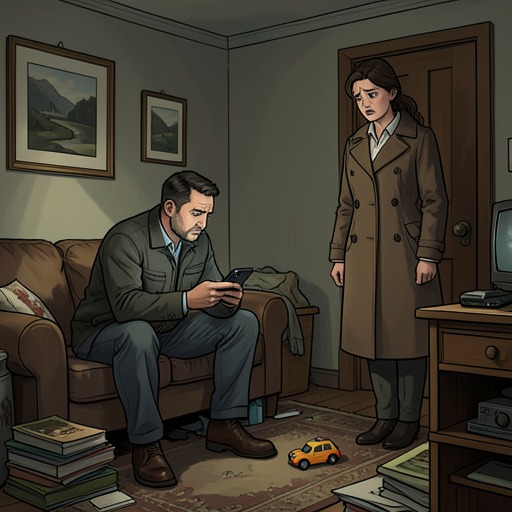
Luke Phillips
The Birthday PartyLuke Phillips is Patrick’s biological father and Chase Cooper’s former detective partner. His place in the story is defined by a gap between biological parenthood and daily care: Shannon Watts’s decisions have kept him at a distance from Patrick, while Chase has spent substantial time raising the boy. Luke’s renewed appearance brings that unresolved family arrangement into the present and gives him a possible route toward greater responsibility in his son’s life.
Identity and Background
Luke’s connection to the central family conflict begins with his former partnership with Chase. Shannon was involved with Luke while she was with Chase, and when she became pregnant, she tried to present the child as Chase’s. Luke insisted on a DNA test, which established that Patrick was his son. This intervention made the biological truth clear, but it did not produce a stable or uncomplicated arrangement for Luke and Patrick.
Shannon left when Patrick was three. By the time the story turns to the current events, Patrick is about eight. Chase remembers that he missed the boy more than he missed Shannon, and that he had spent more time with Patrick than Patrick’s biological father had. The contrast is not presented as proof that Luke does not care; rather, it shows how little opportunity he has had to occupy the ordinary, sustained role of a parent. His paternity is known, but the relationship itself has been interrupted by years of separation.
A Father Kept at a Distance
Luke has tried numerous times to obtain custody, but Shannon has repeatedly left, disrupting those efforts. The narrative does not provide a detailed account of the earlier attempts or specify the legal arrangement between them. It does establish that Luke has been unable to secure consistent access: when he confronts Chase, he complains that he is not even allowed to talk to Patrick. His anger is therefore directed not only at Chase’s renewed involvement with Shannon, but also at the prospect that Chase is again being placed between Luke and his son.
That history complicates the apparent simplicity of biological parenthood. Luke is Patrick’s father, yet Chase has been a familiar adult in Patrick’s life, while Luke has been absent for much of it. The story sets those facts beside one another without treating biology alone as a guarantee of closeness. Luke’s repeated attempts to seek custody suggest an effort to alter the situation, but the evidence leaves the outcome of those attempts unresolved until his renewed decision to act.
Conflict with Chase
Luke’s return becomes visible when he interrupts Chase at work, angry at hearing that Chase and Shannon may be together again and that Chase is once more involved with Patrick. Chase clarifies that he and Shannon have not reconciled: she arrived unexpectedly, let herself into his home with a key she still had, and explained afterward. The distinction matters to Luke because Shannon’s presence in Chase’s life appears to threaten his own already limited access to Patrick, even though Chase describes the visit as uninvited rather than a renewed partnership.
The confrontation also exposes the difference between the two men’s positions. Chase has been left managing the immediate consequences of Shannon’s arrival and is familiar with her pattern of not leaving easily. Luke, meanwhile, is concerned that Chase’s involvement may again take precedence over his relationship with Patrick. Their exchange is tense, but it does not become a permanent personal rupture. Chase eventually redirects the discussion from rivalry toward Patrick’s needs and the practical possibility of a custody arrangement.
The Prospect of Custody
Chase advises Luke to seek legal help and pursue some form of custody. His reasoning is specific: Patrick needs a settled place to live and to be enrolled in school, and Chase doubts that Shannon makes the boy a priority. Chase also distinguishes neglect from physical abuse, saying that Shannon is not beating Patrick. His concern is instead that the child lacks the stability and dependable adult care he needs.
Luke takes the advice seriously. When Chase later explains the situation to him, he acknowledges that Shannon is unlikely to leave immediately and again urges Luke to consider a custody arrangement. Luke’s response is decisive: he nods and says he will make a call before leaving. The moment converts an old grievance into a concrete next step. The story does not establish that Luke files for custody or gains it; it shows him choosing to pursue a legal path after years of unsuccessful attempts.
Narrative Role
Luke’s brief but consequential role makes Patrick’s care a question of relationships and responsibility, not merely of parentage. His paternity was established through the test he insisted upon, yet Chase’s greater history of day-to-day contact gives the two men sharply different kinds of connection to the boy. Shannon’s repeated departures have helped sustain that imbalance, leaving Luke both Patrick’s biological father and a parent whose access remains uncertain.
By directing Luke toward a custody arrangement, Chase shifts the conflict away from suspicion about whether he and Shannon are together and toward Patrick’s need for stability. Luke’s decision to act offers a possible change in the family’s pattern, but the ending remains open: his determination is shown, while the legal and personal consequences are not. His significance lies in that unresolved possibility—that a father long kept at the margins may now attempt to become a more consistent presence in Patrick’s life.